Optical Bonding
The optimal display quality of display components plays a decisive role for all areas of application today. To ensure good readability even in sunlight, a high contrast ratio is necessary. Users also expect accuracy and good operating performance from modern touch screens.
Depending on the application and area of application, we glue touch sensors made of glass and displays to the front glass to form a display module using the so-called optical bonding process. With the LOCA process (liquid optical clear adhesive), we achieve a permanently reliable connection between cover glass and touch sensor and at the same time ensure perfect readability of the display. Optical bonding offers decisive advantages, regardless of the display technology used, especially when using outdoor displays under adverse lighting conditions in sunlight.
Optical bonding for the best view of
the display

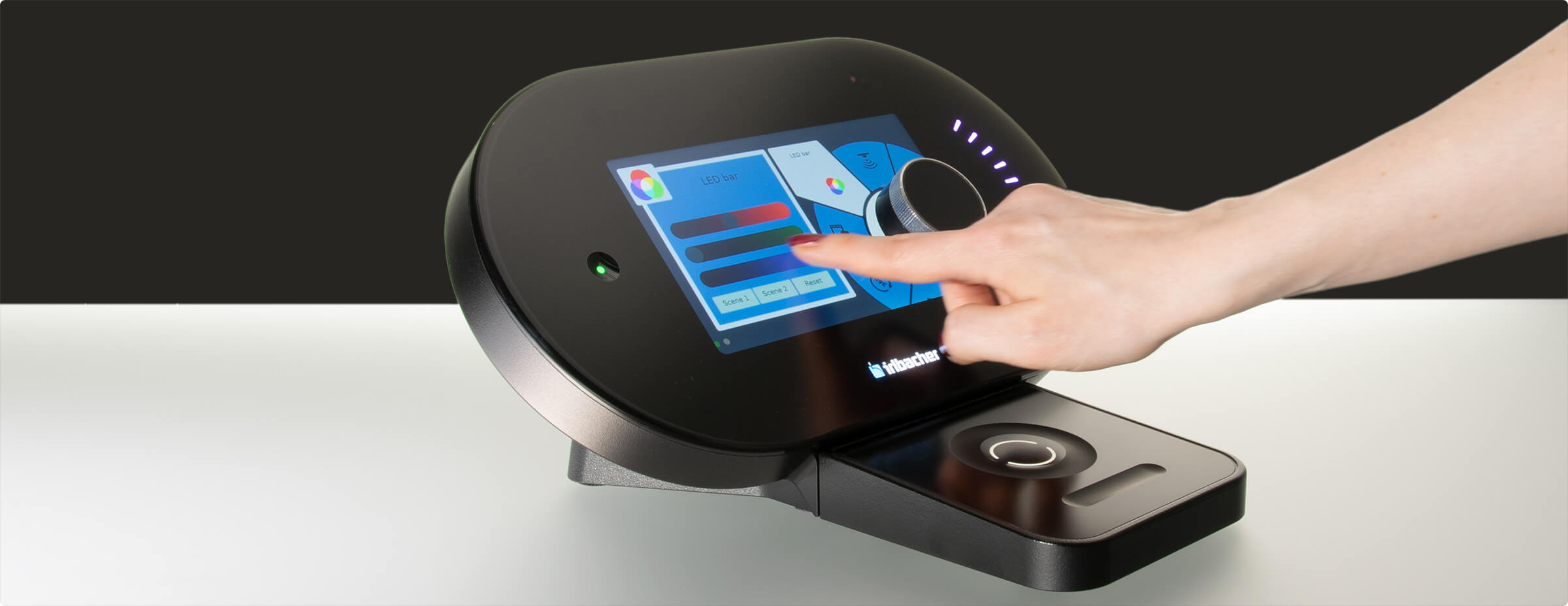
An example of a premium glass control unit for a global market leader. Here, a touch sensor is bonded to the printed cover glass using a fully automated process with a liquid adhesive (optically clear adhesive). The customized display component can now be further processed by the customer into a finished touchscreen or for installation in the intended device.

Experience and processes
With our in-depth expertise as a manufacturer of glass user interfaces, we offer our customers the right process technologies for bonding cover glass, touch sensors, and displays using the optical bonding process. We work with you to develop the best solution for your application or offer you the optimal bonding solution for your assembly.
Optical bonding using the
LOCA process
Liquid adhesive LOCA (liquid optical clear adhesive) is applied to the cover glass in precise doses. The touch sensor or display is then applied and the adhesive spreads evenly and bubble-free between the components. The adhesive is then cured using UV light without generating excessive heat.


Influence on optical properties
During optical bonding, the liquid adhesive completely fills the air gap between cover glass and sensor or display homogeneously and without bubbles. Disturbing light refraction and reflections at the boundary layers of the individual components are eliminated, as the composite now forms a single optical unit. The readability and contrast of the display can thus be significantly optimized. We offer optical bonding to our customers as an adhesive for both film sensors and glass sensors.
Better protection against vandalism and harsh environments
In addition to optical advantages, optical bonding also offers a whole range of mechanical advantages. When the cover glass, touch sensor and display are bonded together, a mechanically robust monolithic composite is created. Optical bonding thus reinforces the entire module and makes it robust and resistant for use in a wide range of applications.

Air-Gap Bonding
As a simple option for manufacturing display components, we offer air-gap bonding. This process is particularly suitable for indoor applications. The display is connected to cover glass or touch sensor using a double-sided adhesive tape, which is applied all around the frame of the display. In this process, the layers of air in the gap between the individual components are retained, resulting in annoying reflections at the interfaces.
Optical bonding - advantages
at a glance
The advantages of optical bonding include the optimal readability of the display even in adverse lighting conditions, the high resistance under extreme conditions and the ability to prevent moisture from forming between the panes in the event of severe temperature fluctuations.

A question of the system
In our production under clean room conditions, the bonding material and process are perfectly coordinated and can be adapted to almost all types of cover lenses, touch sensors and displays. When it comes to bonding, we can process components from different providers in our processes and are able to respond flexibly to customer requirements.
Optical Bonding - Overview of optical benefits
- Significantly reduced reflections, up to 65% less overall reflection
- Fewer reflections of light radiation and therefore easier to read under all lighting conditions
- Higher perceived contrast of the screen, the display appears stronger and clearer, ideal for outdoor, automotive, industrial and marine applications
- Better color rendering by reducing stray light, more saturated colors, less color distortions and higher image depth
- Wider and more consistent viewing angles and stable color display from all directions
- Sharper image and higher “optical focus”, the text appears sharper, touch points appear more precise and the content appears on the glass instead of below
Optical Bonding - Mechanical Benefits Overview
- Higher impact and fracture resistance and therefore significantly more robust against shocks, vibrations and selective loads
- Significantly higher torsional and flexural strength and thus improved resistance in applications in vehicles, machines and outdoor equipment
- Fewer internal tensions and reduced failure rates in harsh environments
- Improved vibration and shock resistance and thus better suitability for industry, military, handhelds, automotive technology
- Lower risk of LCD damage or pixel errors due to continuous vibration
- Optical bonding completely seals the assembly, meaning no detachments caused by particles and higher long-term reliability
- No condensation/no fogging, thus preventing corrosion and structural damage in the display structure
- Impossible for dust to penetrate the module
FAQ
What is optical bonding?
Optical bonding is a process in which a display panel and a cover plate (e.g. glass or touch sensor) are bonded bubble-free with a transparent adhesive. This eliminates the air gap that is common with conventional display structures.
What are the benefits of optical bonding?
Optical bonding improves readability in sunlight, reduces reflections, increases robustness, prevents condensation and provides better overall image quality. It also improves touch and operating accuracy on touch screens.
What adhesives are used in optical
Bonding used?
Typical bonding materials include UV-curing adhesives (LOCA), OCA dry film adhesive (Optical Clear Film), silicon-based adhesives (OCR) or resins, depending on application, temperature range and requirements for optical quality, repairability or robustness.
In which areas of application is optical
Bonding used?
Especially in applications where high readability and robustness are crucial — such as industrial HMI, automotive displays, medical technology, outdoor devices, ticket/information terminals, marine displays or military technology. Typical applications include smartphones and tablets.
How does optical bonding affect durability
off a display?
It increases mechanical strength, reduces the risk of glass breakage, prevents dust and moisture from entering, and minimizes fogging when temperature changes. Overall, the lifespan of the display is increasing
Is optical bonding suitable for every display?
Not every display is readily intended for optical bonding. It depends on the display type, construction, and requirements for heat removal, repairability, and electrical components. A feasibility check is often recommended.
What are the costs for optical bonding?
The costs depend heavily on display size, quantity, bonding material, quality requirements and any additional services (e.g. cleanroom production, tests, individual glasses). The prices per unit are generally higher than for unbonded displays, but often offer economic added value through improved durability and performance. For detailed information, a project-related offer is recommended.


